Introduction to Business Final Summer 2026 Question Paper
0413-112 – Introduction to Business – Summer 2026 – BBA 71 – Final
Added to archive: September 28, 2026
Policy reviewed: 2026-06-27
Contributed by:
Kazi Parvez Hassan
How we publish
 1 / 2
 2 / 2
Full exam question transcript (OCR)
Crawlable text of every question — for study, search, and AI assistants.
| Question/Part | Content | Marks/CLO |
|---|---|---|
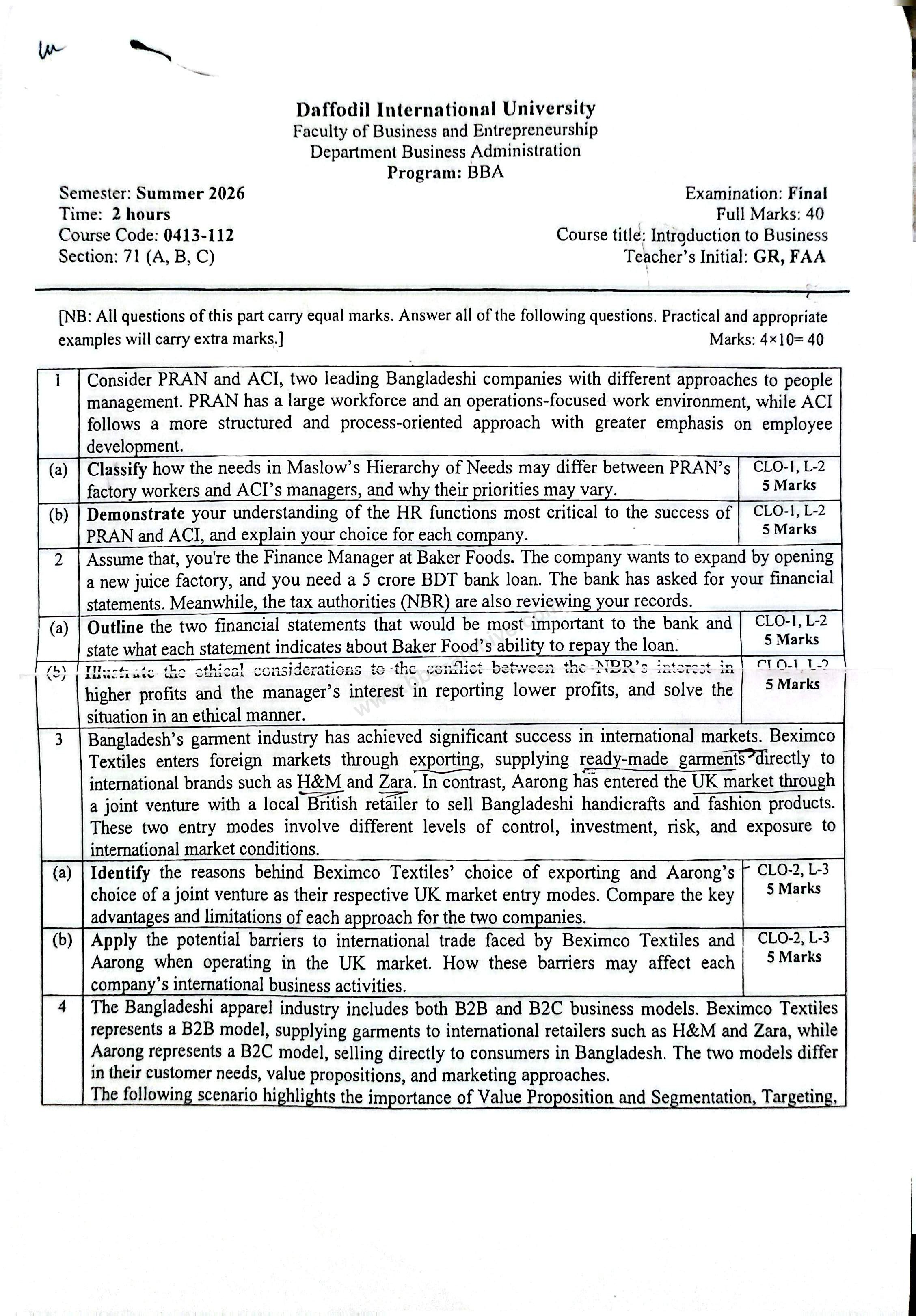
| 1 | Consider PRAN and ACI, two leading Bangladeshi companies with different approaches to people management. PRAN has a large workforce and an operations-focused work environment, while ACI follows a more structured and process-oriented approach with greater emphasis on employee development. | |
| (a) | Classify how the needs in Maslow's Hierarchy of Needs may differ between PRAN's factory workers and ACI's managers, and why their priorities may vary. | CLO-1, L-2
5 Marks | | (b) | Demonstrate your understanding of the HR functions most critical to the success of PRAN and ACI, and explain your choice for each company. | CLO-1, L-2
5 Marks | | 2 | Assume that, you're the Finance Manager at Baker Foods. The company wants to expand by opening a new juice factory, and you need a 5 crore BDT bank loan. The bank has asked for your financial statements. Meanwhile, the tax authorities (NBR) are also reviewing your records. | | | (a) | Outline the two financial statements that would be most important to the bank and state what each statement indicates about Baker Food's ability to repay the loan. | CLO-1, L-2
5 Marks | | (b) | Illustrate the ethical considerations to the conflict between the NBR's interest in higher profits and the manager's interest in reporting lower profits, and solve the situation in an ethical manner. | CLO-1, L-2
5 Marks | | 3 | Bangladesh's garment industry has achieved significant success in international markets. Beximco Textiles enters foreign markets through exporting, supplying ready-made garments directly to international brands such as H&M and Zara. In contrast, Aarong has entered the UK market through a joint venture with a local British retailer to sell Bangladeshi handicrafts and fashion products. These two entry modes involve different levels of control, investment, risk, and exposure to international market conditions. | | | (a) | Identify the reasons behind Beximco Textiles' choice of exporting and Aarong's choice of a joint venture as their respective UK market entry modes. Compare the key advantages and limitations of each approach for the two companies. | CLO-2, L-3
5 Marks | | (b) | Apply the potential barriers to international trade faced by Beximco Textiles and Aarong when operating in the UK market. How these barriers may affect each company's international business activities. | CLO-2, L-3
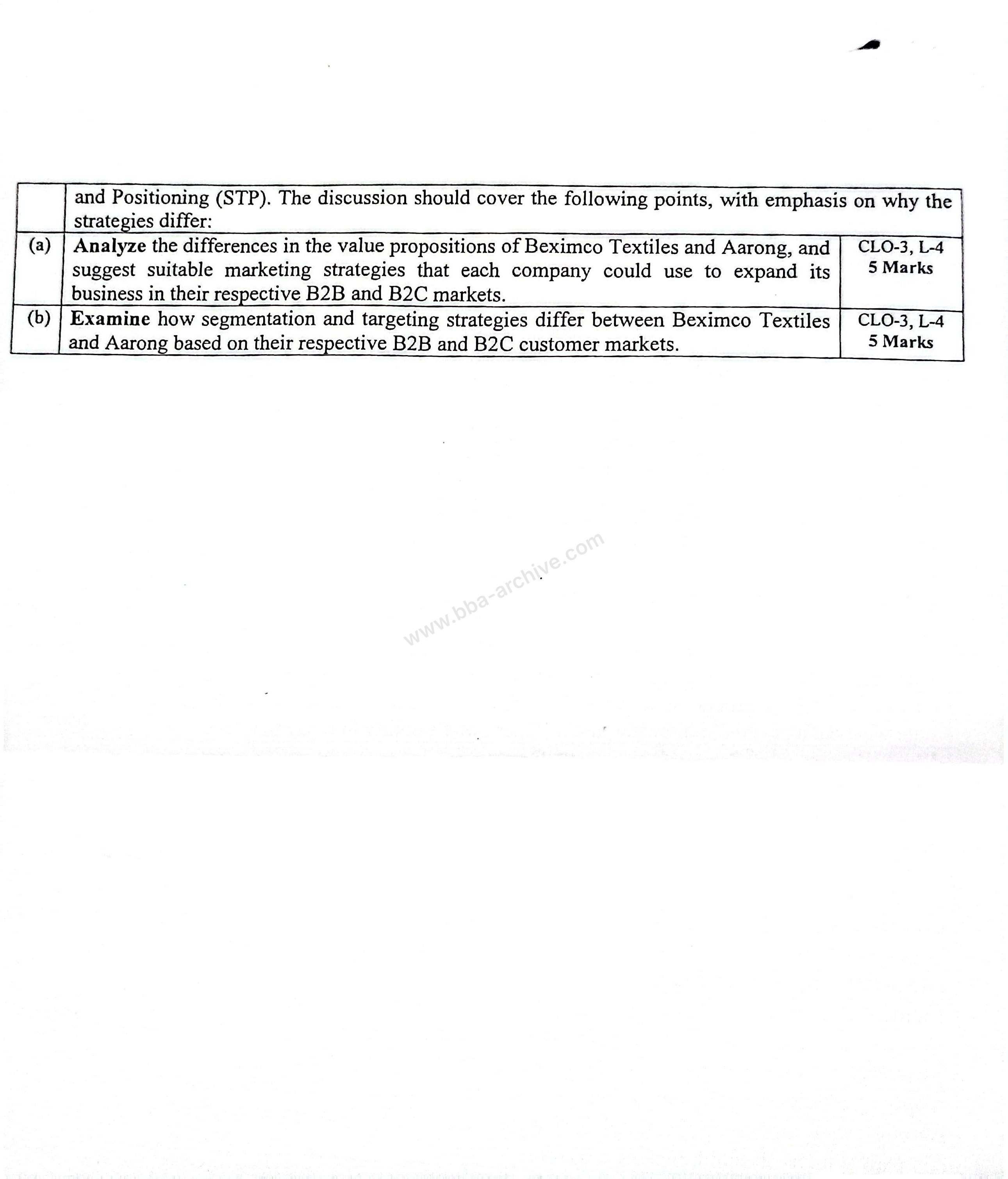
5 Marks | | 4 | The Bangladeshi apparel industry includes both B2B and B2C business models. Beximco Textiles represents a B2B model, supplying garments to international retailers such as H&M and Zara, while Aarong represents a B2C model, selling directly to consumers in Bangladesh. The two models differ in their customer needs, value propositions, and marketing approaches. The following scenario highlights the importance of Value Proposition and Segmentation, Targeting, | |
About this exam paper
Past paper for Introduction to Business (0413-112), Summer 2026 Final. A detailed breakdown will be added by our editorial team.
More from Introduction to Business
0413-112 – Introduction to Business – Summer 2026 – BBA 71 – Midterm
Summer 2026 Midterm
0413-112 – Introduction to Business – Fall 2026 – BBA 72 – Midterm
Fall 2026 Midterm
0413-112 – Introduction to Business – Fall 2026 – BBA 72 – Midterm
Fall 2026 Midterm
0413-112 – Introduction to Business – Fall 2026 – Midterm
Fall 2026 Midterm
Principles of Finance – Summer 2026 – Midterm
Summer 2026 Midterm
Introduction to Business – Spring 2024 – Final
Spring 2024 Final
Introduction to Business – Spring 2024 – Midterm
Spring 2024 Midterm
Introduction to Business – Fall 2025 – Final
Fall 2025 Final
Introduction to Business – Spring 2026 – Midterm
Spring 2026 Midterm
Introduction to Business – Spring 2026 – Midterm
Spring 2026 Midterm
Introduction to Business - Mid Summer 25
Summer 2025
Introduction to Business MID Question
Fall 2025